
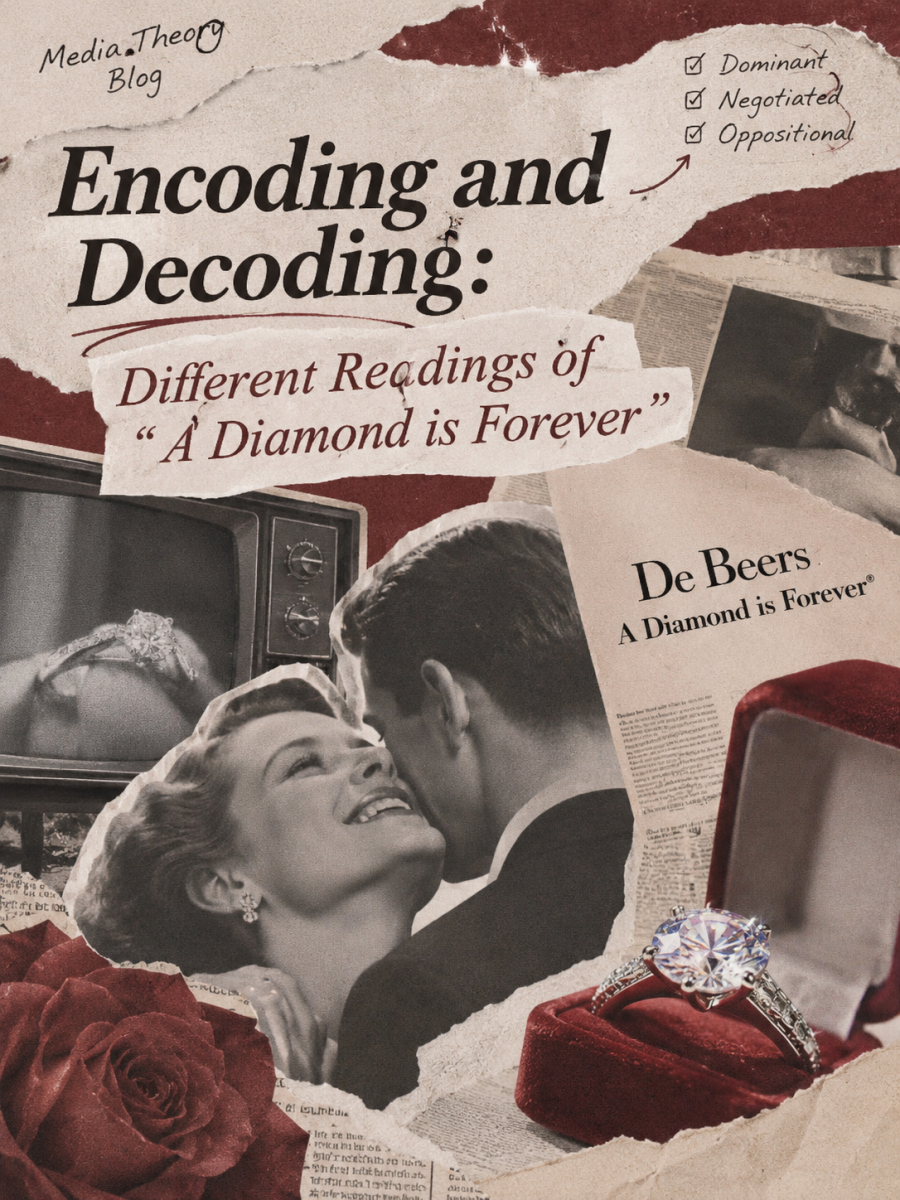
When we think about marriage proposals, why do we often imagine a diamond ring? Is it because diamonds naturally represent love, or because advertising has influenced the way we think?
A famous example is De Beers’ slogan, A Diamond is Forever”. The campaign connects diamonds with everlasting love, marking them as more than just expensive jewellery. But does everyone understand this message in the same way?

Hall (1980) introduced the theory of encoding and decoding, explaining that media producers create messages with particular meanings, but audiences may interpret them differently depending on their experience and beliefs.
Hall (1980) suggests three possible ways audiences can interpret media messages: dominant, negotiated, and oppositional readings.
For example, De Beers uses the idea of everlasting love to give diamonds a romantic meaning. This is the message the brand wants consumers to understand.
This picture from:www.messika.com
Some people may accept this message and believe that a diamond ring is an important part of marriage. This is a dominant reading. Yet, others may agree that diamonds are romantic but feel that expensive is not necessary to prove love. This is a negotiated reading. However, some people may reject the message. They might believe that love should not be connected to the price of the ring. This is an oppositional reading. These different reactions show that even when advertisers try to communicate a particular meaning, audiences do not always accept it.
Personally, I think diamonds can be a beautiful symbol of love, but I don’t believe they are necessary for a meaningful relationship. What matters more is the commitment between two people, rather than the price of the ring. My own response is closer to a negotiated reading. I can see why a diamond ring feels romantic. For me, a simple ring could carry just as much meaning because it represents the same commitment.
Reference:
Hall, S. (1980) ‘Encoding/decoding’, in Hall, S., Hobson, D., Lowe, A. and Willis, P. (eds.) Culture, Media, Language. London: Hutchinson, pp. 128–138.


