

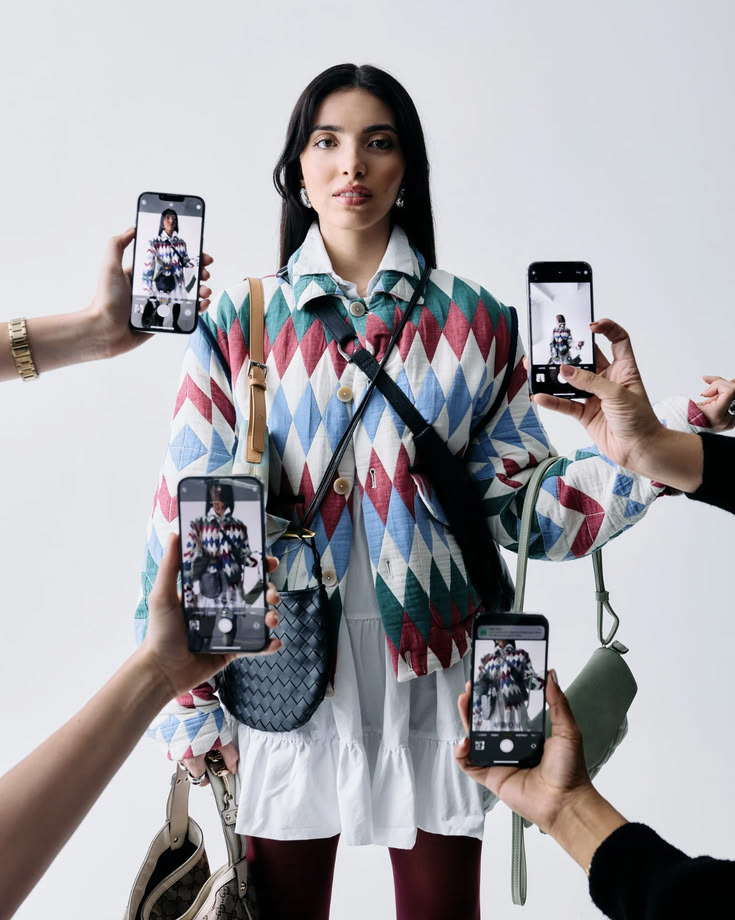
Why do we trust influencers on Social Media?
- Introduction
Social media has transformed the way people access information and make decisions. Many people in today’s society no longer rely on traditional media and advertising, but instead turn to influencers for advice and recommendations. Platforms such as TikTok and Xiaohongshu enable influencers to share their experiences and influence their followers’ choices. This raises an important question: why do people trust influencers? And how does their influence relate to the two step flow theory?
- Understanding the Two-Step Flow Theory
In two step flow theory, it is often believed that mass media does not influence audiences directly but the information flows first to opinion leaders who then analyse and spread the same among other people (Harff, Stehr, and Schmuck, 2025). Opinion leaders in social media have the ability to influence social media users because they pass the information to the followers and influence them. Therefore, the process of communication in social media has become more complicated than in the original theory.
- The Influence of Internet Celebrities
For instance, influencers often voice their opinions about the products, fashion, and lifestyle on social media sites like TikTok and Xiaohongshu. Compared to conventional ads, it might be more relatable to hear someone talk about their experience using certain products. Additionally, the opinions of opinion leaders might not always depend on how many followers they have. For instance, one might believe the opinions of a beauty influencer with fewer followers compared to those of a popular celebrity because they see the former’s opinions as more genuine (Korzynski et al., 2025). It is evident that influencers may affect people’s opinions, yet their opinions cannot always be considered credible since they get paid for advertising certain products.
- My Personal Experience and Reflection
I remember once seeing a beauty blogger on Xiaohongshu recommending a liquid foundation. At first, I wasn’t particularly keen on buying this product, but the blogger demonstrated how the foundation looked on the skin and compared the difference before and after application. Compared to a standard advert, I found this approach more convincing, as I could see the product’s effects straight away. I even went on to search for other reviews before deciding whether to buy it.
Looking back now, I realise that this blogger actually acted as an influencer, shaping my first impression of the product. However, I’ve also come to realise that even if a blogger gives a product a positive review, it doesn’t necessarily mean it’s suitable for everyone.

- Critical Discussion and Conclusion
While the theory of the two step flow seems to help us understand the impact of online celebrities, in my opinion, it fails to capture fully the way we use social media nowadays. Not only do we get the information from opinion leaders; we can also read comments, compare various opinions and give our own feedback.For instance, I may be interested in purchasing a certain product on the recommendation of a specific blogger, however, unfavorable comments from other members may sway me away as well. This shows that online communication is more complicated than the two-step flow theory suggests. In my opinion, online celebrities have an influence on our choice but they do not completely control it.
Reference
Harff, D., Stehr, P. and Schmuck, D. (2025). Revisiting opinion leadership in the digital realm: Social Media Influencers as proximal mass opinion leaders. New Media & Society. doi:10.1177/14614448251336441.
Korzynski, P., Protsiuk, O., Moulard, J.G. and Jain, V. (2025). Opinion leadership in a digital age: The rise of nano and micro-influencers. Telematics and Informatics, [online] 102, p.102328. doi:10.1016/j.tele.2025.102328.
Pinterest. (2020). Algorithm aesthetic | collage illustration, collage design, social media. [online] Available at: https://www.pinterest.com/pin/instagram-and-snapchat-are-ruining-our-memories–2533343530784919/ [Accessed 19 Oct. 2026].
Pinterest. (2026). Digital influence: Content creation at IMM | branding photography content creation, brand photography for social media, brand social media content creation aesthetic. [online] Available at: https://www.pinterest.com/pin/751045675405809277/ [Accessed 19 Oct. 2026].


