
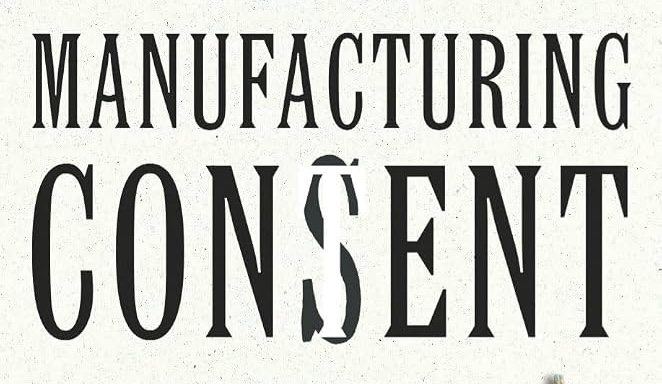
When we see the news, read newspaper headlines or scroll through social media we tend to think that the information we get is a true reflection of what is happening in the world. But how much of our belief is determined by the way the news is delivered to us? Manufacturing Consent is a phrase coined by Edward S. Herman and Noam Chomsky in 1988 to describe how powerful institutions can influence public opinion via the media. One has to wonder: are the audiences really coming up with their own conclusions or are they being led to think a certain way?
In their book Manufacturing Consent: The Political Economy of the Mass Media (1988), Herman and Chomsky argue that the mainstream media can serve the interests of powerful political and economic groups. They came up with the Propaganda Model. It outlines five filters that influence the news people get. These include media ownership, advertising, dependence on official sources, negative responses to critical reporting (flak), and dominant political ideologies. Together these filters can determine which stories are noticed and how stories are framed.
A case in point is the media coverage leading up to the 2003 invasion of Iraq. In the run-up to the invasion, the US government repeatedly asserted that Iraq had weapons of mass destruction (WMDs). These claims drew substantial media coverage and helped generate public support for military action. But subsequent investigations failed to find the purported stockpiles of WMDs. It does raise questions about how much the media relies on what the government says and if journalists challenged official claims enough before relaying them to the public.
Another important part of manufacturing consent is how some stories get more attention than others. News organisations are short of time and resources and so choices have to be made about what events deserve coverage. But when politics enters the mix of these decisions, some perspectives might be less visible. This doesn’t mean journalists are necessarily lying to audiences. There’s a bit of a deadline and a dependence on the usual suspect sources that can sometimes determine what is reported.
This problem today is not limited to the conventional newspaper and television. Social media platforms like TikTok and X can disseminate information rapidly, but audiences are also exposed to content curated by algorithms. Political messages, headlines, viral videos can shape how people understand an issue, often before they’ve looked into the full story.
Ultimately, Manufacturing Consent reminds us that consuming news isn’t simply a matter of receiving information. It also involves knowing who produces it, what interests it may serve and what views are absent. As readers we should question what we read and not believe the first version of a story to be the truth. Because to know what’s going on is not just to know what’s going on, but to know how we are being told what’s going on.
References
- Chomsky, N and Herman, E. S. (1988) Manufacturing Consent: The Political Economy of the Mass Media. New York: Pantheon Books.
- Chomsky N. (1989) ‘A Propaganda Model’, in The Chomsky Reader. Available at: https://chomsky.info/consent01/
Vastano, A. (2025) ‘Manufacturing a Common Enemy Through the Anti-Terrorism Filter: An Analysis of the Bush Administration and American Media’s Roles in Justifying the 2003 Invasion of Iraq’, The General: Brock University Undergraduate Journal of History.


It is an engaging article that you have focused on how the media affects our views even though we do not realise it. It teaches us the necessity of verification of information, cross checking it with other sources and using our critical thinking abilities instead of being gullible.