

We expect journalists to question powerful people, not simply repeat their claims. Yet before the US-led invasion of Iraq in 2003, allegations that Saddam Hussein’s government possessed weapons of mass destruction (WMD) received prominent coverage. The claimed stockpiles were never found. How could reporting make the case for war seem more convincing?
Herman and Chomsky (1988) explain this possibility through their propaganda model. They identify five filters: ownership, advertising, sourcing, flak and anti-communism, the original ideological filter. These pressures can overlap, but this analysis focuses on sourcing. Journalists need reliable, timely information, and governments can supply briefings, documents and access to officials. This gives powerful institutions a regular place in news coverage, while less connected critics may struggle to be heard.
Younge (2004) reports that The New York Times later acknowledged weaknesses in its pre-war Iraq reporting, including insufficient scrutiny of Iraqi defectors’ claims. An early front-page story treated aluminium tubes as possible evidence of a nuclear weapons programme. Doubts about that interpretation received much less prominent attention, appearing on page 13. The difference matters because a dramatic initial claim can reach many readers, while its qualifications may reach far fewer.
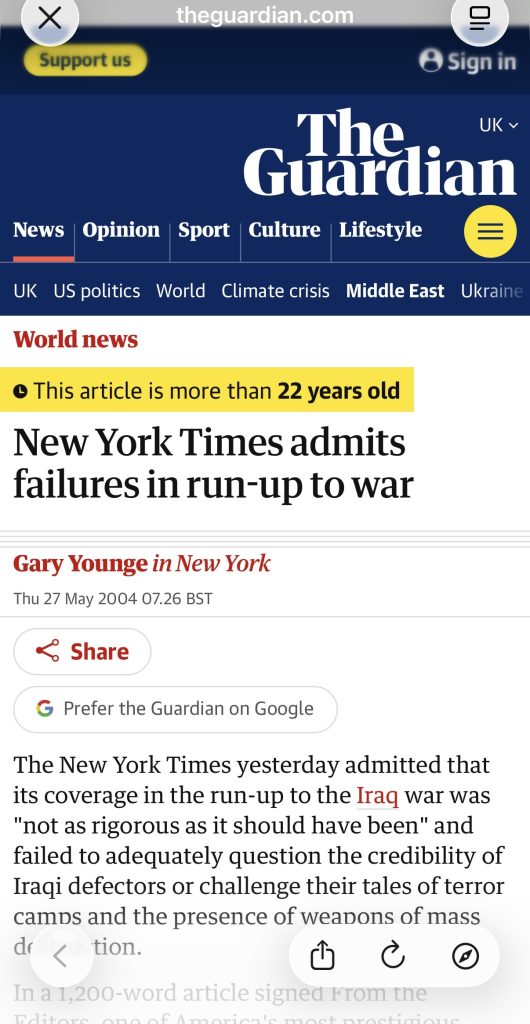
As Figure 1 shows, The Guardian reported the newspaper’s admission. The screenshot documents that later acknowledgement; it does not itself show the original page placement. Younge’s account provides that detail. Together, these points suggest how sourcing can shape not just what gets reported but what appears most credible.
Here is the possible route to manufacturing consent: claims from influential sources gain prominent coverage; competing evidence gets less attention; and a disputed threat can begin to seem established. That could make military action appear more justified without journalists openly advocating war.
Kull, Ramsay and Lewis (2003) found that 23% of respondents holding none of three Iraq-related misperceptions supported the war, compared with 86% of those holding all three. The study also records uneven misperception rates across audiences of different outlets, such as Fox News and PBS/NPR. Yet this is an association, not proof that The New York Times caused those beliefs. Political preferences may influence both news choices and attitudes towards war, complicating any causal claim.
Hall’s (1980) encoding/decoding approach adds another limit to the propaganda model: audiences can accept, negotiate or reject dominant messages. Hall’s model explains textual openness but not why oppositional readings were unevenly distributed across audiences. Manufacturing consent is therefore neither automatic nor universal.
This distinction matters because a mistake by one newsroom is not, by itself, proof of a system-wide propaganda process. The sourcing filter describes where dominant narratives originate, yet it struggles to fully explain why counter-narratives are systematically marginalised. Nor should we assume that all newspapers reported Iraq in the same way: sceptical reporting existed, and readers encountered different accounts. The theory is most useful when it helps us investigate these patterns rather than treating bias as a foregone conclusion.
The problem is not journalists quoting officials; they often must. It is failing to scrutinise powerful claims and give serious counter-evidence comparable visibility. The Iraq case shows how unequal attention may narrow public debate even without an explicit campaign to persuade.
In conclusion, the media did help manufacture consent for the Iraq War, not through intentional propaganda, but through routine news production shaped by the sourcing filter.
References
Hall, S. (1980) ‘Encoding/decoding’, in Hall, S., Hobson, D., Lowe, A. and Willis, P. (eds.) Culture, Media, Language: Working Papers in Cultural Studies, 1972–79. London: Hutchinson, pp. 128–138.
Herman, E.S. and Chomsky, N. (1988) Manufacturing Consent: The Political Economy of the Mass Media. New York: Pantheon Books.
Kull, S., Ramsay, C. and Lewis, E. (2003) ‘Misperceptions, the media, and the Iraq War’, Political Science Quarterly, 118(4), pp. 569–598. doi: 10.1002/j.1538-165X.2003.tb00406.x.
Younge, G. (2004) ‘New York Times admits failures in run-up to war’, The Guardian, 27 May. Available at: https://www.theguardian.com/world/2004/may/27/media.iraq (Accessed: 16 November 2026).


