
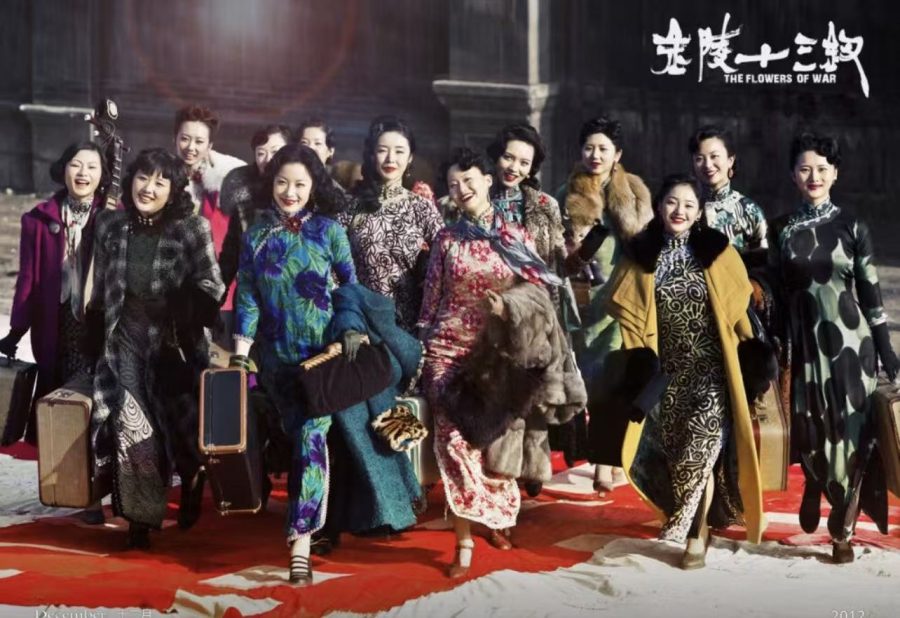
It’s something you’d think only the crassest of Hollywood producers would come up with — injecting sex appeal into an event as ghastly as the Nanjing massacre — but it’s an element central to The Flowers of War (McCarthy, 2011)
The Flowers of War, directed by Zhang Yimou and released in 2011, is a historical drama set during the 1937 Nanjing Massacre. Centred on a group of sex workers and young schoolgirls hiding in a foreign church, the film tells a tragic story of sacrifice. Beneath its moving surface, however, its visual language and character design can be read through Laura Mulvey’s theory of the male gaze. The film creates a rigid visual divide between two groups of women, objectifying one group through fetishised shots while stripping the other of feminine identity.
The film repeatedly draws a clear distinction between the sex workers and the schoolgirls.
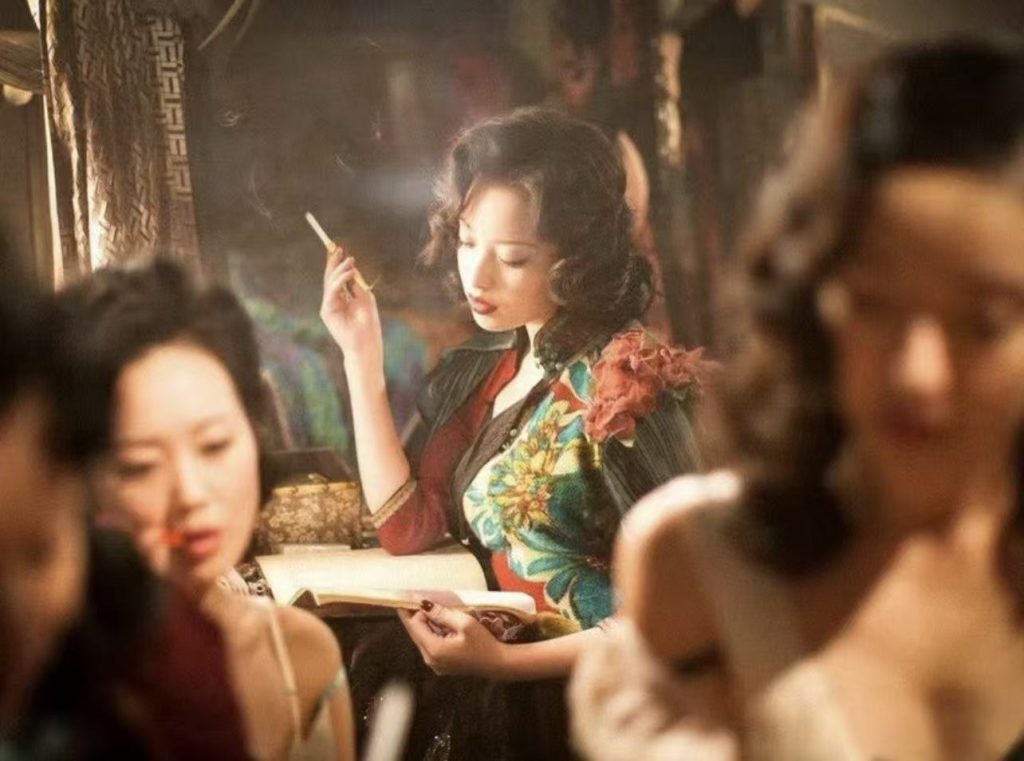
The women from the fishing lane, led by Yumo, are dressed in gorgeous outfits and elaborate makeup. Even while fleeing in the bitter cold winter, these thirteen sex workers wear thin undergarments beneath their clothes, unlike the other characters wrapped in thick cotton coats. There are many shots of them running away and climbing over fences. Their cheongsam hems lift up as they move, revealing stockings and thighs. Many of these shots are captured from low angles. This is a clear fetishistic example of the male gaze.
At the same time, cheongsams, stockings, red lipstick, thighs and hips are all attached to these sex workers. These sexually coded features construct a particular image of an Oriental woman.
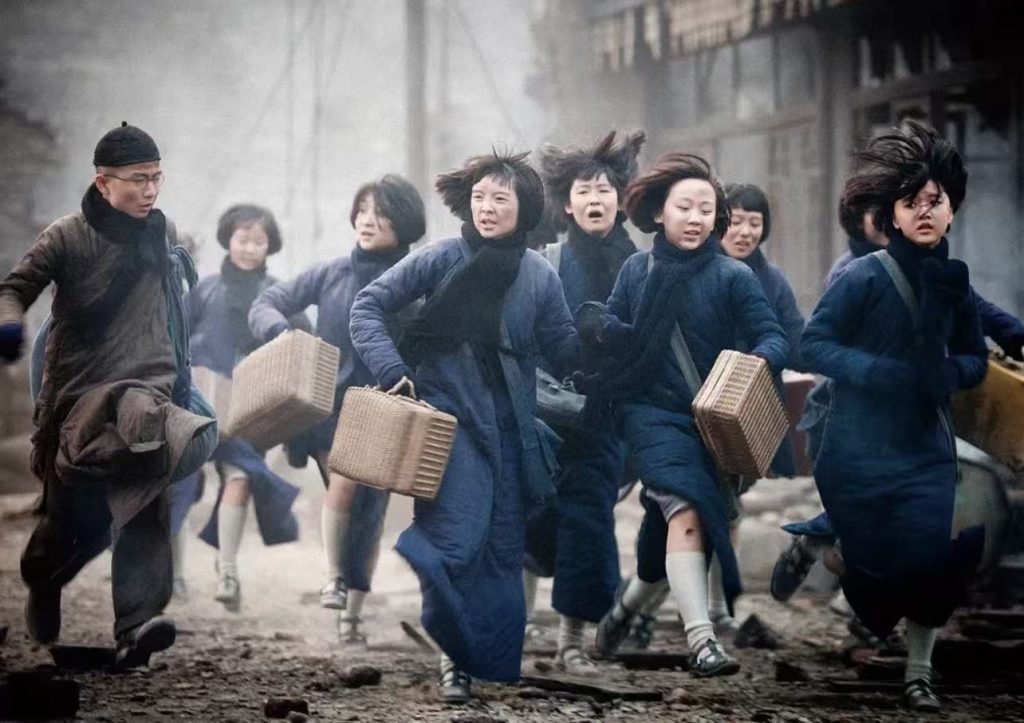
By contrast, the schoolgirls wear loose dark blue cotton uniforms and short plain hair, with no makeup. Their looks carry almost no feminine markers. The camera mostly uses eye-level or high angles to frame their faces rather than their bodies, presenting them as desexualised figures. This visual contrast lingers constantly before the audience’s eyes and shapes how we perceive their fates.
The ending contains a striking scene. As the sex workers put on the schoolgirls’ uniforms, slow motion, soft lighting and dramatic music all suggest that they regain purity and dignity through this sacrifice. The camera lingers closely on their fingers undoing cheongsam buttons, the act of taking off stockings and the moment their backs are exposed. These details are filmed with great aesthetic care. Yet the sequence feels unsettling on reflection: few women would undress with such polished grace in a private moment. What is more, the male hero receives no comparable visual treatment before facing death — only these female heroes are subjected to this gaze before their sacrifice. The basement becomes like a makeshift stage, with Yumo and the other women placed upon it for the audience to watch.
On the level of cinematography, many scenes set inside the church and during the characters’ escape linger on close-ups of the women’s cheongsam, figures and curves. Even trapped amid the terror of war, the camera first frames them as an attractive visual spectacle, rather than centring their panic, pressure and urgent desire to survive.
Narratively, the core premise of the film builds around the exchange of these sex workers’ bodies to save young schoolgirls. Their value is largely constructed around the possibility of bodily sacrifice. Their personal wishes and inner lives rarely receive deep exploration. The redemptive, heroic narrative arc belongs to male characters such as John and Lieutenant Li, while these women remain figures to be watched and rescued.
Crucially, this analysis does not dismiss the weight and nobility of their sacrifice. Instead, it unpacks how the film’s storytelling and shot design guide the audience to appreciate their feminine charm first, rather than inviting us to inhabit their subjective perspective and feel their terror and difficult choices. The tension McCarthy points out — placing sex appeal within an unspeakable historical tragedy — reveals exactly how the male gaze can embed itself even in serious, high-budget historical dramas.


