
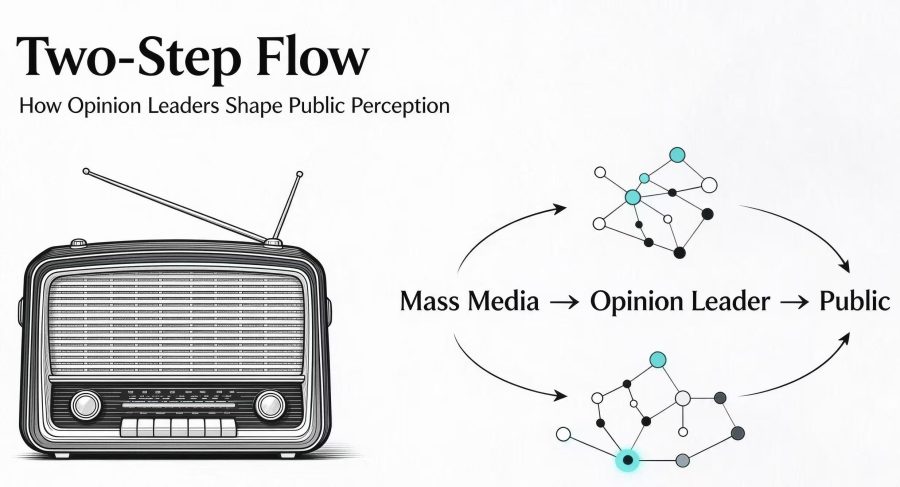
Since the early 20th century, scholars held the view that mass media could directly shape audience opinions, known as the “hypodermic needle model”. The two‑step flow theory challenged this idea. Mass media seldom reaches ordinary people directly. Instead, information flows from mass media to opinion leaders and then spreads to the public through social communication. Platforms like Instagram, TikTok and X (formerly Twitter) show how this classic theory explains modern online influencers.
The two-step flow theory was first proposed by Paul Lazarsfeld. It originated from his Erie County Voting Survey, which studied voters’ decisions in a US presidential election. Lazarsfeld discovered newspapers and radio had less direct impact on voters than talks with community contacts. These influential people are opinion leaders: they closely follow media content, process information and share their interpretations with others.
This theory divides communication into two phases. First, media sends information to opinion leaders. Second, these leaders interpret, filter and pass information to their social circles. It moved communication studies beyond the idea of passive audiences and highlighted the importance of social networks.
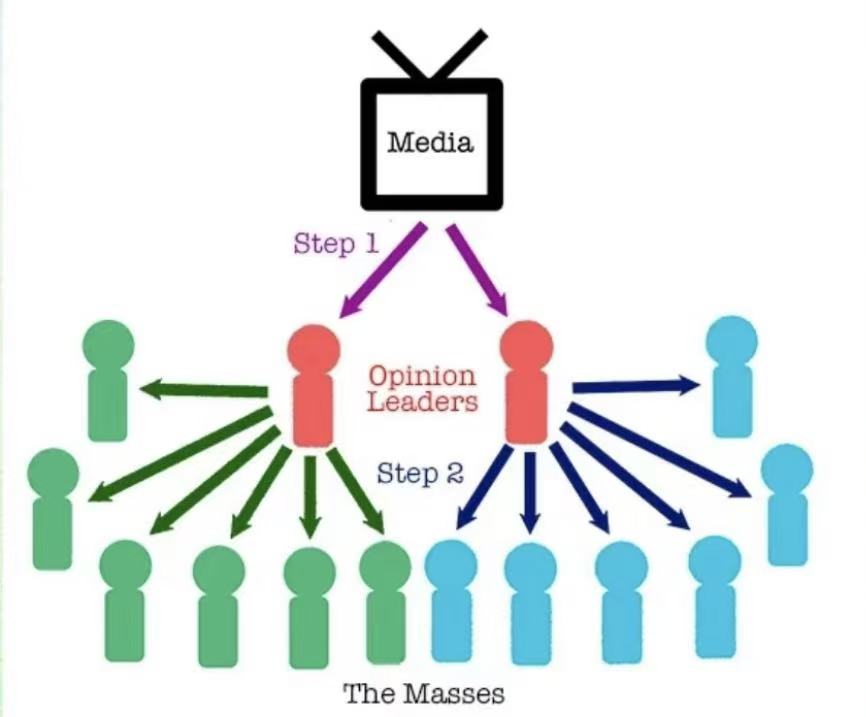
(Figure 1: The two-step flow of communication model)
Today, social media has reshaped the two‑step flow. Modern opinion leaders are KOLs, subject experts and niche community influencers. We can observe this mechanism using the UK Net Zero Strategy as a real‑world example.
The UK government released its official Net Zero Strategy: Build Back Greener as a foundational policy document via the GOV.UK website (Department for Energy Security & Net Zero, 2021). This policy document sets national targets to cut carbon emissions and achieve net‑zero by 2050. The report was widely shared across social‑media platforms including X (formerly Twitter).
Step one of communication: The official government document acts as the original mass‑media information source. It first reaches environmental scientists, campaigners and industry specialists, who function as opinion leaders.
Step two of communication: These experts read the dense official policy, unpack its complex technical content, evaluate its strengths and weaknesses, and produce simplified explanatory posts for their followers on social media. This secondary interpretation and sharing completes the second step of the two‑step flow.
These opinion leaders do not merely forward raw official information. They translate technical policy wording, assess real‑world impacts and add independent commentary. Their viewpoints strongly shape how ordinary social‑media users understand and judge the government’s climate plan.
Unlike opinion leaders in Lazarsfeld’s 1940s study, modern‑day online experts can reach huge audiences instantly. However, this digital transformation also brings new risks. Opinion leaders may simplify, distort or even commercialise information. Audiences receive filtered information, which may lead to biased understandings.
Critics also point out the limits of the two‑step flow theory. Some audiences actively search for original official documents online, skipping opinion leaders entirely. People no longer have to rely on intermediaries to access information. Algorithmic recommendation systems also change the path of information. Platform algorithms push content directly to users, creating a one‑step communication path that the original theory did not predict. Moreover, the theory tends to overemphasise the role of opinion leaders while ignoring that audiences can resist or reject the ideas shared by influencers.
Even with these limitations, the two‑step flow theory remains a valuable analytical tool. It reminds us that mass communication is not simply a one‑way transmission from media to audience. Information is filtered, reinterpreted and spread through social relations. In today’s social media ecosystem, influencers act as modern opinion leaders, mediating between official sources and the public. Understanding this process helps us stay critical when consuming content online, recognising that what we see is often not raw facts, but information processed by intermediaries.
Reference
Cho, J., 2020. Two‑step flow of communication in social media: A systematic review. Journal of Communication Inquiry, 44(4), pp.327‑348.
HM Government, 2021. Net Zero Strategy: Build Back Greener. Policy paper, 19 October. GOV.UK. Available at: https://www.gov.uk/government/publications/net-zero-strategy
Lazarsfeld, P.F., 1944. The people’s choice: How the voter makes up his mind in a presidential campaign. Columbia University Press.


