
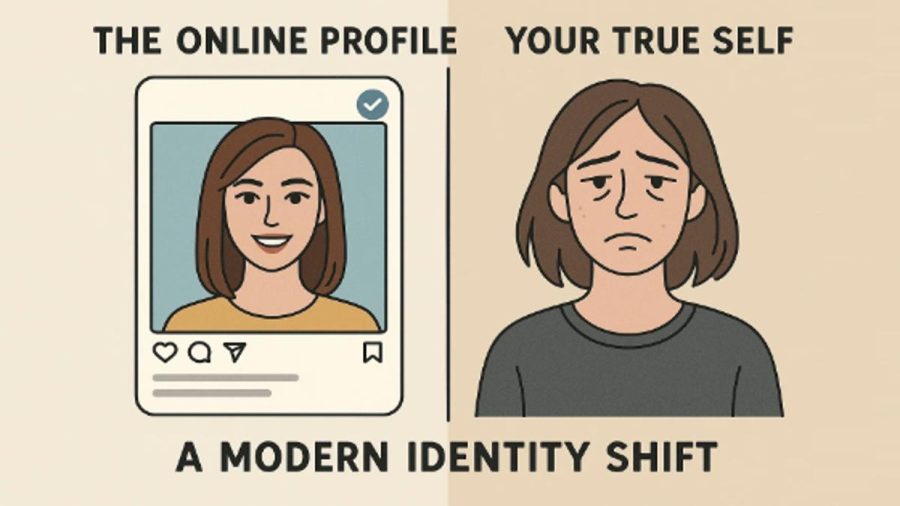
Social media has become a huge part of how we communicate, but it also allows us to carefully manage how we come across to others. From choosing the perfect Instagram photo, to creating a curated personality on TikTok, our online identities rarely reflect our full selves and we often show selected versions of who we are.
This links to Erving Goffman’s theory of self-presentation (Goffman, 1959, cited in Hogan, 2010), where he compares everyday social interactions to a performance and suggests that people change the impression they create depending on their audience. For example, my Instagram mostly features holidays, celebrations and being out with friends, while leaving out things I deem less exciting or which remind me of difficult times. This doesn’t mean my posts are fake, just that I choose what parts of my life I want people to see.
Bernie Hogan (2010) develops Goffman’s ideas, identifying the difference between how we perform in person and online presences. Unlike a real time conversation, online profiles allow content to be edited and viewed repeatedly, making identity creation more purposeful. Users can select, remove and rearrange content until they’re happy with how they’re represented to an audience that they may never meet in person. I find this interesting because Instagram profiles can become photo galleries of a person’s highlights.
However, individuals aren’t the only influence on how identities are presented. McLuhan’s (2006) idea that ‘the medium is the message’ suggests that the platform itself influences how we communicate. Instagram encourages visual presentation and aesthetics, whereas TikTok focuses more on videos and trends. This also links to Williams’ (Laughey, 2007) discussion of technology and cultural form, which challenges the idea that technology alone determines society – technology develops within existing social and cultural conditions, while also influencing them. For example, Instagram’s focus on visual content reflects wider cultural interests in appearance and lifestyle, but it may also encourage people to place more importance on these things because platforms can reinforce these expectations. This means the way we present ourselves online isn’t just down to our own choices, but is also influenced by the platforms we use.
I also think the reactions we get online contribute to how we present ourselves. Likes, comments and views can encourage people to post more of what gets a positive response. Over time, this could influence what someone considers attractive, interesting or acceptable to share. This raises the question of whether people are presenting themselves mainly for their own enjoyment, or increasingly changing their identities to meet the expectations of others. If the version of ourselves that receives the most positive response is one we continue to present, could this eventually influence how we see ourselves outside of social media?
In conclusion, I don’t think constructing an online identity necessarily means being fake. We all behave differently depending on who we’re with; we all ‘code-switch’ in some form. Social media is another place to manage how we’re perceived, but there’s a difference between choosing what to share and feeling pressure to maintain a certain image. Maybe the better question isn’t whether our online identities are fake, but whether the versions of ourselves we create influence who we become in real life.
References:
Hogan, B. (2010) ‘The presentation of self in the age of social media: Distinguishing performances and exhibitions online’, Bulletin of Science, Technology & Society, 30(6), pp. 377–386. doi: https://doi.org/10.1177/0270467610385893.
Laughey, D. (2007) Key Themes in Media Theory. Maidenhead: Open University Press.
McLuhan, M. (2006) ‘The medium is the message’, in Durham, M.G. and Kellner, D.M. (eds.) Media and Cultural Studies: KeyWorks. Revised edn. Malden, MA: Blackwell Publishing, pp. 107–116.


Hi Rebekah! I really enjoyed reading your blog, and I strongly agree with your ideas. Social media cannot capture the full version of who we are. We often choose to present different sides of ourselves.
For example, the photos I share on social media are usually taken after I have dressed up, done my makeup and found a good angle. However, I am not always like this in real life. Sometimes I go to class without putting much effort into my appearance or spend my time rushing to finish assignments. I would not choose to share these moments publicly on social media. Even if I occasionally take photos of these everyday moments, I only make them visible to myself as a way of recording my daily life.
I also think that we do not only choose how to present ourselves, but are also influenced by other people’s feedback. For example, when people in the comments suggest certain styles that might suit me, I sometimes take their advice and try them out. This makes me realise that the image we present on social media is not entirely shaped by our own choices. Other people’s opinions and feedback can also influence how we see ourselves and what kind of image we want to present to others.