
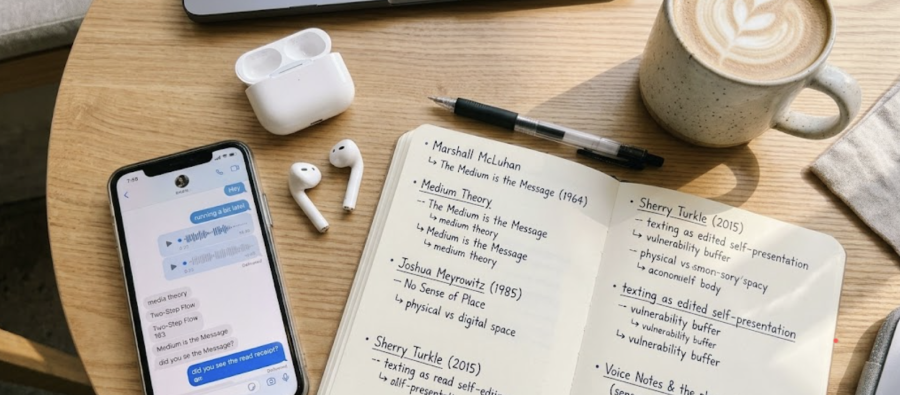
Have you ever stared at a blinking cursor for ten minutes, rewriting a two-sentence message just to make sure you didn’t sound “too blunt”? Or, on the flip side, hesitated before tapping the microphone icon because sending a voice note suddenly felt a little too intimate, almost like knocking on someone’s door unannounced?
We tend to assume that messaging apps like WhatsApp, LINE, or Instagram DMs are simply neutral pipelines for information. We tell ourselves that as long as the words convey the same message, the format doesn’t really matter. But does it?
When Canadian philosopher Marshall McLuhan famously declared in 1964 that “the medium is the message” he challenged the conventional way we think about communication. His argument was provocative: the content of a message is often a distraction. What truly transforms human psychology, relationships, and societal norms is the technological architecture of the medium itself. Decades later, Joshua Meyrowitz (1985) expanded on this by showing how electronic media break down traditional physical boundaries, reorganizing who has access to which social situations.
Looking at my own phone today, I realize we are living through a textbook example of Medium Theory without even noticing it.
For years, asynchronous texting has been our generational comfort zone. Why? Because text provides a protective emotional buffer. When you type, you possess absolute editorial control: you backspace, insert an emoji to soften the tone, rearrange words, and calculate your exact level of casualness before hitting send. As media theorist Sherry Turkle (2015) observes, digital text allows us to “edit, and if we wish to, delete” our vulnerability. But that very frictionlessness comes with a hidden psychological cost. Because text strips away the human body—breath, hesitation, vocal pitch, and acoustic texture—it reduces communication to flat, disembodied symbols. It invites constant overthinking: Why did they use a period instead of an exclamation mark? Why did they read it and take twenty minutes to reply?
Now, consider the meteoric rise of voice notes.
When you switch from the keyboard to holding down the microphone button, the entire social dynamic flips. The medium instantly reintroduces the physical body into digital space. Even in a 20-second audio clip, your cadence, vocal fry, genuine laughter, and ambient background sounds are fully exposed. You cannot backspace half a sentence without scrapping the whole recording, forcing an unfiltered spontaneity that text actively suppresses.
For the receiver, popping in headphones to listen to a voice note requires focused cognitive and emotional presence. You can’t skim an audio waveform the way you glance at a text banner on your lock screen. The raw “content” might be identical—a simple “Hey, running ten minutes late!”—yet as a text message, it reads like flat logistical coordination; as an out-of-breath voice note recorded while rushing down the stairs, it communicates visceral warmth and genuine urgency. The medium completely dictates the emotional reality of the interaction.
So, when we talk about digital connection, maybe we shouldn’t just be asking what we are saying to each other. The more pressing question is: how is the interface choosing to connect us?
Do voice notes bring back the authentic human presence that texting erased, or are they just an exhausting demand for our undivided attention in an already overwhelmed digital life? What does your chat history say about the mediums you choose to hide behind—or be seen through?
References (Harvard Style)
- Gillespie, T. (2014) ‘The Relevance of Algorithms’, in Gillespie, T., Boczkowski, P.J. and Foot, K.A. (eds.) Media Technologies: Essays on Communication, Materiality, and Society. Cambridge, MA: MIT Press, pp. 167–194.
- McLuhan, M. (1964) Understanding Media: The Extensions of Man. New York: McGraw-Hill.
- Meyrowitz, J. (1985) No Sense of Place: The Impact of Electronic Media on Social Behavior. New York: Oxford University Press.
- Turkle, S. (2015) Reclaiming Conversation: The Power of Talk in a Digital Age. New York: Penguin Press.


