
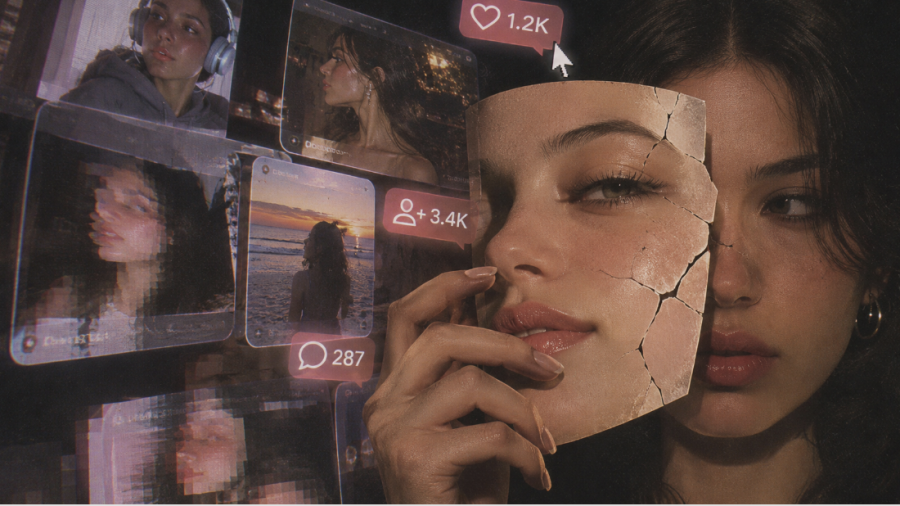
Imagine an everyday scenario where you open instagram or TikTok to post a picture. However before you post it, you start thinking about the lighting, the angle, caption, and most prominently how other people are going to interpret it. It might cause you to delete it or choose an entirely different picture. The question is at what point does sharing a part of yourself become creating a version of yourself.
Arguably, one of the most fascinating things about living in a digital world is that identity has become something that we constantly curate, almost like it’s a personal brand. Simply introducing ourselves to people is no longer the priority. We are now presenting carefully selected versions of ourselves to an audience that we cannot always even see.
This concept has a key connection to Erving Goffman’s dramaturgical theory, which is noted in the Presentation of Self in Everyday Life (1959). In this text Goffman compares social interaction to a theatrical performance, where individuals act differently depending on their audience and surroundings. The distinction he makes between the ‘front stage’ and ‘backstage’ is particularly interesting when applied to social media. Our Instagram profiles can be seen as the front stage: a space where we select what to show, from our interests and friendships to our appearance and lifestyle. All while the backstage represents the aspects of ourselves that remain private. But with the influence of social media the separation becomes more difficult. Even our supposedly spontaneous moments can become performances once we decide to photograph and share them.
What adds complexity is a concept called context collapse, which was discussed by Marwick and boys (2010) In our everyday life, we behave in a different manner around our friends, family and colleagues. However online, these sorts of audiences can exist in the same sphere. A picture that was originally intended for friends might also be viewed by family members or future employers, thus we become more conscious of how different people may interpret the same post. Essentially we are trying to perform more than one identity simultaneously, whilst not even knowing exactly who is watching
What becomes the most intresting question is, whether these performances are uniquely our own choices. Social platforms have transformed our identity into something that can be measured through things such as likes, followers and views. This causes us to associate visibility with value and popularity with social approval. Social relations can become mediated with time through images and representations. In social society today, it is possible to become more concerned with documenting an experience than actually experiencing it. A holiday can become a collection of photographs. A meal can become content. And a social gathering can become an opportunity to create something that is worth posting.
I find this particularly interesting because I don’t necessarily think presenting different versions of ourselves makes us fake. It is due to the fact that we naturally adapt to different environments, and that is part of being human. But even with that in mind, there is a difference between expressing different sides of ourselves and feeling pressured to become someone entirely different to receive approval.
Perhaps the biggest irony of the whole idea of digital identity is that while platforms may encourage us to express our individuality, they also simultaneously encourage us to follow trends, aesthetics and behaviours that have already been popularised. We want to stand out, but often use the same visual language as everyone else.
Thus, if our identities are shaped by our audiences and the expectations of others, how much of the person we present online is actually ours? Perhaps the real challenge of digital identity is not learning how to present ourselves better, but remembering that we do not have to turn every part of ourselves into a performance.


