
From Newsrooms to TikTok: How the Two Step Flow Theory Affects Our Opinions
Introduction: Who Decides What We Believe?
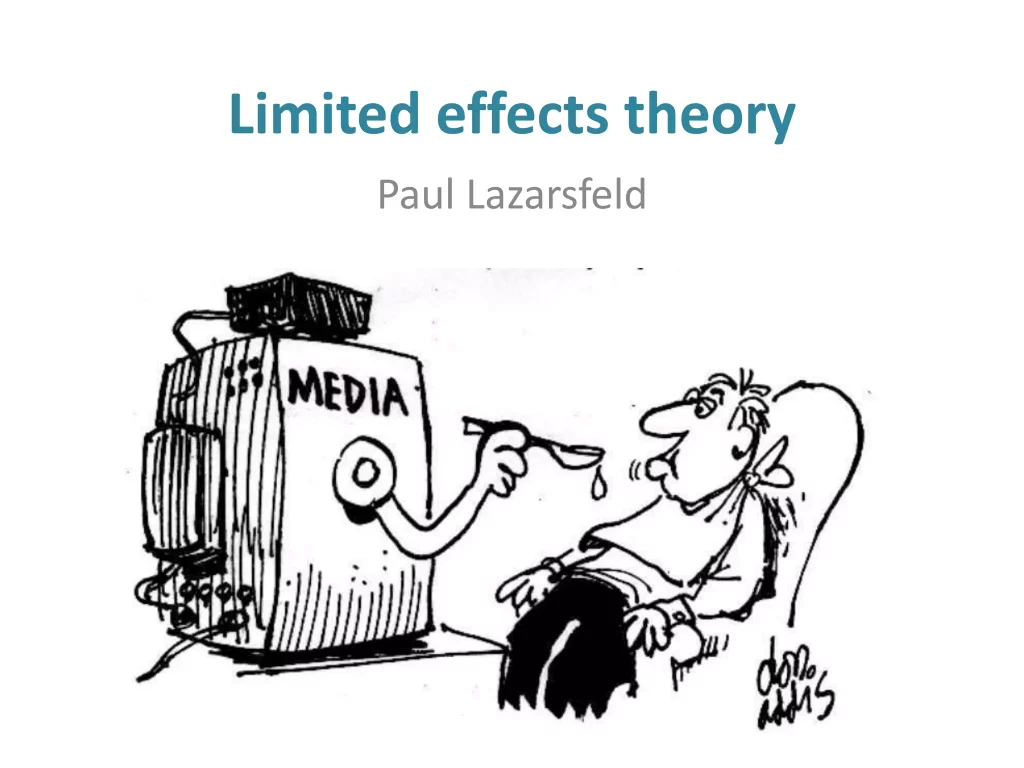
Ever watch a TikTok creator explain a news story and then share it to your friends? This daily experience is an example of an idea that was conceived decades before social media existed, the Two Step Flow Theory. It tells us that media messages do not affect everybody in the same way, but they reach people through influential people.
The Two-Step Flow Theory Explained
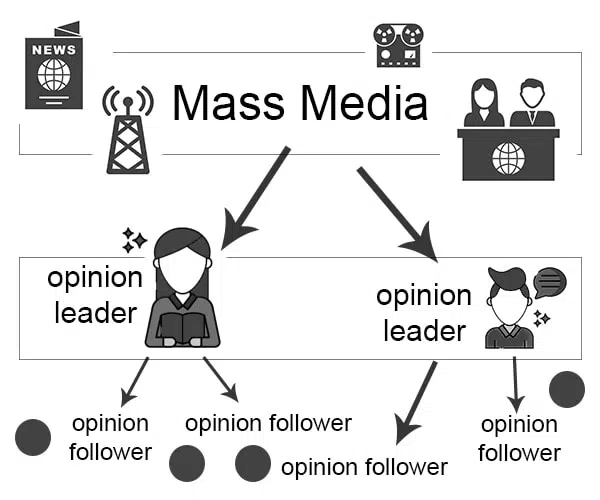
The theory was developed by Paul Lazarsfeld and colleagues from their study of voting behaviour in the 1940 U.S. presidential election. What they found challenged the assumption that mass media works independently on each audience member. Rather, information often flows from mass media to opinion leaders, who interpret and pass it on to others (Lazarsfeld, Berelson and Gaudet, 1948).
Opinion leaders are people whose knowledge, interests or social ties lead others to trust their opinions more. Katz and Lazarsfeld (1955) further investigated the effects of interpersonal relationships on attitudes and decisions.
How the Two-Step Flow Theory works
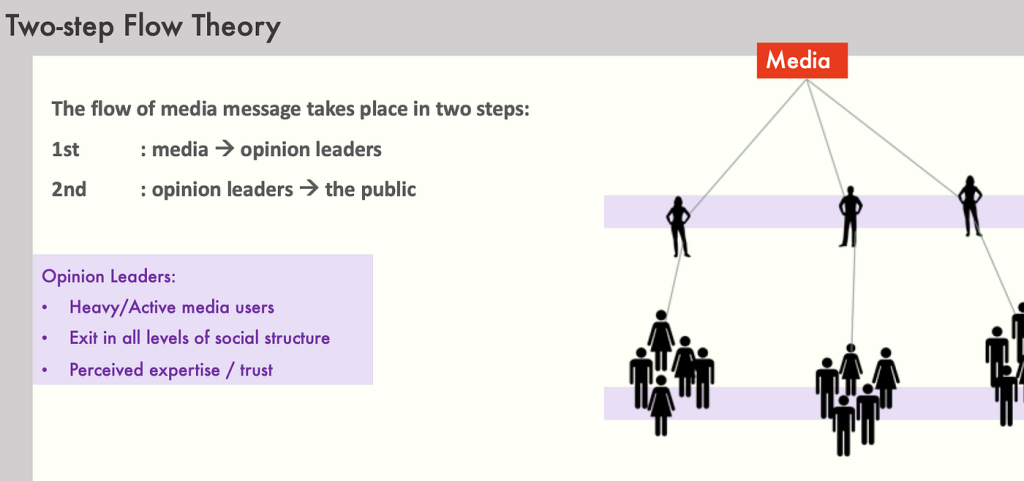
Mass media (news websites, television and newspapers)
↓
Opinion leaders (influencers, commentators and trusted friends)
↓
Audiences (followers, communities and social networks)
From the newspapers to tiktok
Though formulated in the twentieth century, the theory is still relevant in the digital world today. Think about a piece of political news. A newspaper publishes a report, but many find out about it from a YouTuber’s explanation, an Instagram post, or a TikTok video. The creator chooses what information to include, adds commentary and presents it in an accessible format.
This shows how opinion leaders can shape not only what audiences are exposed to but how they interpret it. Followers’ perceived relatability and familiarity might lead them to view social media influencers as trusted sources (Harff, Stehr and Schmuck, 2025).
But such influence creates problems for journalists. Influencers are able to explain complex issues and promote political participation but they can also misrepresent events or spread false claims. Sometimes emotional storytelling can trump factual accuracy . When audiences have more faith in personalities than the original source .
Is communication still a two-step process?
The modern media complicate the theory’s original simplicity. News audiences can get the news straight, question influencers, comment on reports and share information themselves. Algorithms also decide which content is visible, creating additional pathways for messages to circulate.
Scannell (2007) frames early mass communication research in the larger context of discussions about media and society. This historical perspective emphasises the necessity of considering not only media messages but also the social relationships through which audiences encounter them.
So today’s communication is better thought of as a network of interconnected influences than a strict two step process. But the theory is still useful for understanding why some voices become credible and shape public discussion.

Social media has created new opinion leaders who influence how audiences discover and interpret news.
Conclusion: Think before you post
The Two Step Flow Theory shows that media effects are partly dependent on trust, relationships, and opinion leaders. Influencers can teach audiences in the digital era, but popularity doesn’t equal accuracy.
As responsible media consumers we should ask who is telling a story, look at the evidence and check claims from reliable sources. Today’s complex media landscape makes it even more important to understand the flow of information (SAGE, pp. 9–30.)
References
Durham, M.G. and Kellner, D. (eds.) (2006) Media and Cultural Studies: KeyWorks. Revised edn. Malden, MA: Blackwell Publishing.
Katz, E. and Lazarsfeld, P.F. (1955) Personal Influence: The Part Played by People in the Flow of Mass Communications. Glencoe, IL: Free Press.
Lazarsfeld, P.F., Berelson, B. and Gaudet, H. (1948) The People’s Choice: How the Voter Makes Up His Mind in a Presidential Campaign. 2nd edn. New York: Columbia University Press.
Scannell, P. (2007) Media and Communication. London: SAGE, pp. 9–30.


