
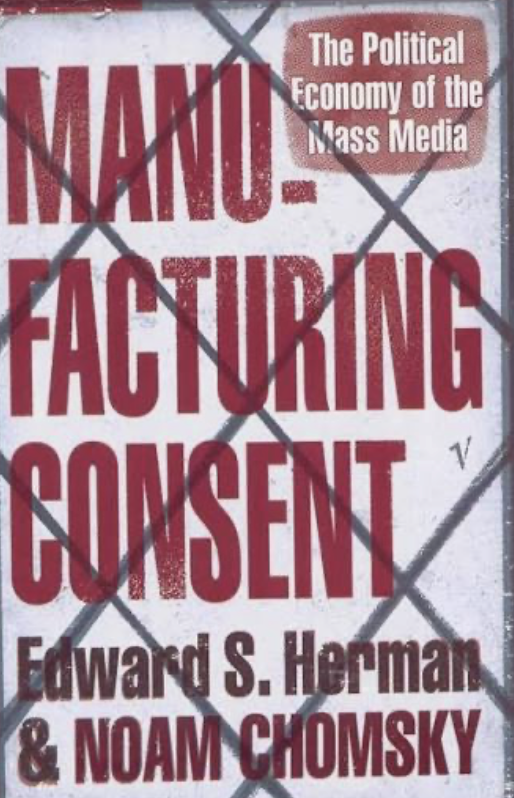
We have absorbed in information in modern-day society. News websites, social media, TV, have significant roles in the shaping of one’s society. However, an important query still exists: are we forming our own opinions or is our opinion shaped by the information? This is what the concept of Manufacturing Consent is all about according to Edward S. Herman and Noam Chomsky (1988).
Understanding Manufacturing Consent:
In Manufacturing Consent: The Political Economy of the Mass Media, Herman and Chomsky propose that conventional media does not merely relay information objectively. Rather, media corporations can construct public attitudes through the process of choosing what stories to cover and how to report them.
The scholars introduce the Propaganda Model, which identifies five filters impacting media content: ownership, advertising, reliance on information from the elite, negative feedback against media companies also known as (flak), and prevailing ideology. These filters can create the news that audiences read or see while supporting elite political and economic interests.
Manufacturing Consent in the Digital Age:
Even if this theory was originally conceived in the context of the conventional mass media, it still applies to the current-day digital realities. Thanks to social media platforms such as Instagram, TikTok, Facebook and X, information has changed considerably in terms of production, distribution and consumption.
The algorithms used play a significant role in what users will see in terms of content, based on their interests, their level of engagement and the way they behave on the Internet. Therefore, at times people can come across the same ideas and opinions, which later may lead to creating echo chambers and confirming the opinion of users.
For instance, during elections or major events, several messages can be disseminated and widely spread due to trends and influencers, and the opposite opinion can be disregarded. This is the situation that brings up questions concerning the influence of social networks in the public sphere that is not usually considered by their users.
Moreover, it is economy that dominates the social media landscape as far as revenues and engagement. Thus, this situation is in line with the claims of Herman and Chomsky regarding the influence of the economy on media.
The Importance of Manufacturing Consent:
Learning about the concept of manufacturing consent is crucial because it teaches us how the mass media shapes and disseminates information. At the same time, social media platforms enable people to voice their opinion, oppose the established views, and present stories that would not be covered by traditional media. Therefore, we should carefully analyse what we see in the virtual world and always verify the truth behind the information we consume, recognise bias, and be aware of how social networks govern our media consumption.
Conclusion:
In conclusion, Manufacturing Consent provides important insight into how media shapes perceptions. While digital media has opened many new channels of communication, it is still influenced by politics and corporations whose control permeates internet communications. For this reason, users should not take all information at face value and remain always suspicious of what they view online. Critical thinking is essential for better media literacy.
References:
Herman, E.S. and Chomsky, N. (1988) Manufacturing Consent: The Political Economy of the Mass Media. New York: Pantheon Books.
Herman, E.S. (2000) ‘The propaganda model: A retrospective’, Journalism Studies, 1(1), pp. 101–112.
Pariser, E. (2011) The Filter Bubble: What the Internet Is Hiding from You. New York: Penguin Press.


